






Quick Summary
Not every enterprise eCommerce platform can handle complex B2B operations at scale. SparkLayer stands out among the best enterprise eCommerce platforms in 2026, adding advanced wholesale functionality without requiring a replatform. Shopify Plus excels for scalability, while Adobe Commerce is a strong choice for businesses that need deep customisation.
Here are our top three picks:
| # | Tool | Best For |
|---|---|---|
| 1 | SparkLayer | Serious B2B and wholesale operations |
| 2 | Shopify Plus | Fast-growing enterprise brands |
| 3 | Adobe Commerce | Highly customised enterprise commerce |
Why Enterprise eCommerce Platform Choice Matters
Complex catalogues, multiple brands, and deep back-office dependencies. That's the reality of running enterprise eCommerce. Without the right platform, this level of complexity becomes harder to manage as you scale.
This guide compares the top 10 best enterprise eCommerce platforms in 2026 including Sparklayer and Shopify Plus. We discuss honest tradeoffs, realistic total cost of ownership analysis, and give you practical decision frameworks to make the right choice.
Why Listen to Us
SparkLayer is a B2B eCommerce specialist trusted by 3,000+ global brands including Mooncup, Teapigs, and Nature's Path. We've helped apparel, industrial, and wellness merchants turn manual wholesale processes into self-serve revenue engines, and we know where platforms break at scale.
10 Best Enterprise eCommerce Platforms
Here's a quick side-by-side look at each tool:
| # | Platform | G2 Rating | B2B Native? | Best For |
|---|---|---|---|---|
| 1 | SparkLayer | 4.9 (360+ reviews) | Full B2B layer | Enterprise wholesale on Shopify |
| 2 | Shopify Plus | 4.4 (4,500+ reviews) | Partial | DTC-first enterprise brands |
| 3 | Adobe Commerce | 4.2 (500+ reviews) | Yes | Complex B2B manufacturers |
| 4 | BigCommerce Enterprise | 4.2 (460+ reviews) | Yes | SaaS simplicity at enterprise scale |
| 5 | Salesforce Commerce Cloud | 4.1 (500+ reviews) | Yes | Salesforce ecosystem brands |
| 6 | commercetools | 4.4 (200+ reviews) | Yes | Teams building composable commerce |
| 7 | SAP Commerce Cloud | 3.9 (200+ reviews) | Yes | SAP ERP-native enterprises |
| 8 | Spryker | 4.4 (140 reviews) | Yes | Manufacturers and distributors |
| 9 | Oracle Commerce Cloud | 3.8 (100+ reviews) | Yes | Oracle ERP enterprises |
| 10 | OroCommerce | 4.2 (Gartner Peer Insights) | Yes | Complex B2B operations |
1. SparkLayer
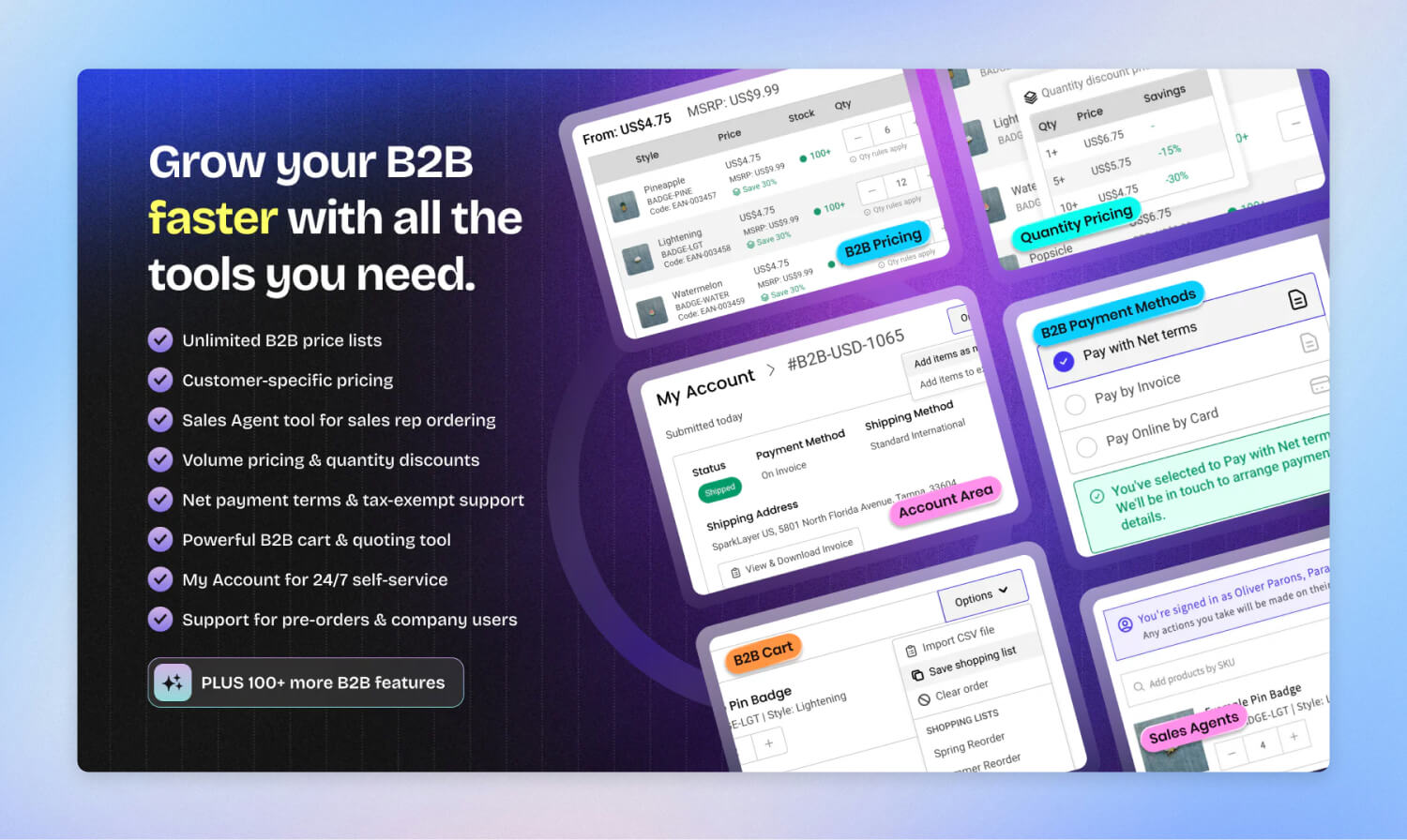
SparkLayer is a B2B layer that turns Shopify, Wix, WooCommerce, or BigCommerce stores into wholesale portals without replatforming or disrupting DTC operations. It runs invisibly on top of your store, enabling a branded B2B buyer portal, custom pricing, and self-serve ordering while your retail site stays unchanged.
Key Features
- Sales Agent Ordering: Reps log into your actual storefront, toggle between accounts, access customer-specific pricing, build carts, and complete orders on behalf of buyers.
- Quoting Engine: Full quote-to-order workflow with a built-in messenger for back-and-forth negotiation; confirmed quotes convert directly to orders.
- AI Intelligent Cart: Buyers forward an order email, PDF, or spreadsheet and SparkLayer reads the file and builds the cart automatically.
- ERP and accountancy bridge: Real-time sync with Sage, NetSuite, Brightpearl, Cin7, Xero, QuickBooks, Unleashed, and Linnworks.
- B2B Buyer Portal: Buyers can manage their own orders, account history, net terms, shopping lists, and credit limits through a branded self-serve portal.
Pricing
A 14-day free trial is available for all paid plans.
✓Pros
- Layers on top of your existing store and goes live in days, not months
- Purpose-built B2B depth that Shopify native lacks at any plan
- Genuine human customer support, no bots or ticket triage involved
- Reduces order processing time by up to 150% every week
- Built-in quoting engine for end-to-end quote-to-order workflows
- Syncs changes in real time, eliminating overnight batch jobs
✕Cons
- Requires an existing eCommerce platform to get the most out of it
2. Shopify Plus
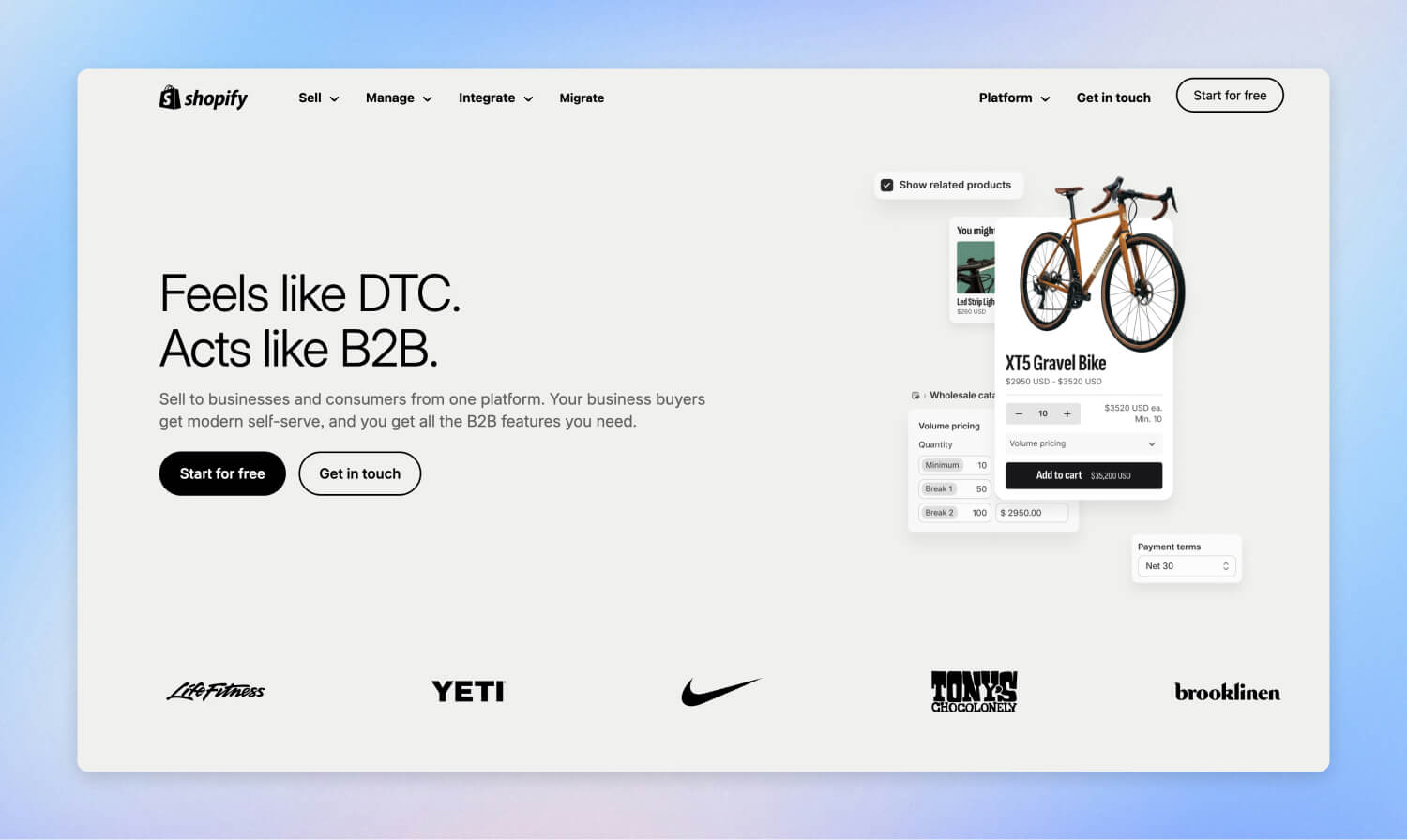
Shopify's enterprise tier is a SaaS platform built for high-volume DTC brands. It handles hosting, scaling, and comes with a large app ecosystem and partner network. It's fast to launch and now includes native B2B features, though complex wholesale setups often require third-party tools.
Key Features
- Multiple B2B catalogues: Customer-specific catalogues and per-buyer pricing come built in on every plan, with up to 9 expansion stores on Plus.
- Shopify Flow: Visual workflow automation for inventory alerts, customer segmentation, and order routing without custom development.
- Shopify Scripts: Custom checkout logic for discounts, shipping rates, and payment methods at the enterprise tier.
- Multi-Location Inventory: Up to 200 inventory locations with real-time allocation rules and fulfilment prioritisation.
Pricing
$2,300/mo (3-year) or $2,500/mo (1-year), plus 0.15% transaction fee if not using Shopify Payments and 0.18% B2B fee.
✓Pros
- Fastest SaaS launch path for standard workflows
- Vendor-managed hosting, security patching, and scaling
- Largest talent pool and partner ecosystem of any platform
✕Cons
- Deep B2B exceptions require third-party apps
- Liquid templating limits front-end structural changes without headless build
3. Adobe Commerce (Magento)
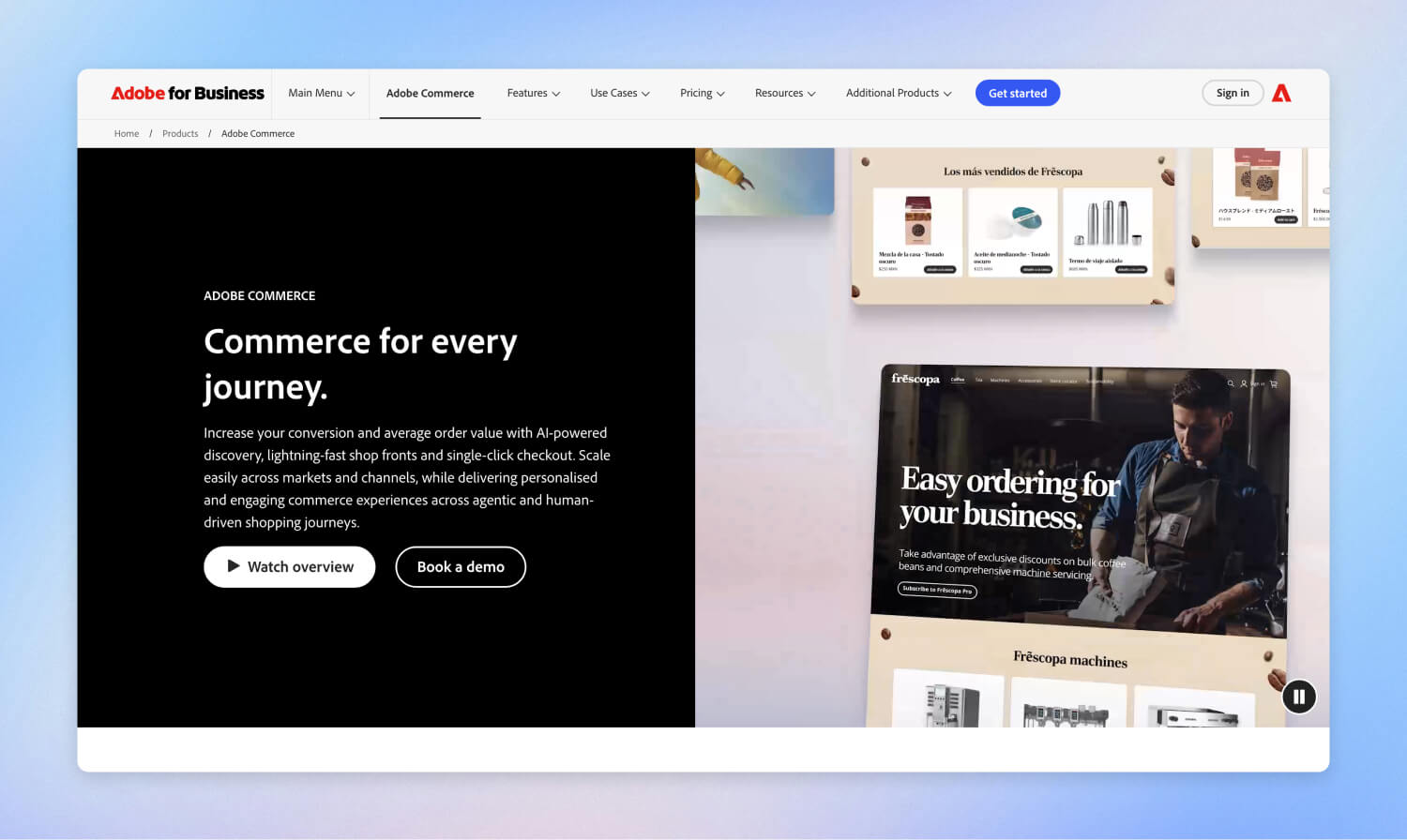
Adobe Commerce is an extensible enterprise eCommerce platform offering deep code-level control over data models, customer groups, and merchandising logic. Part of Adobe Experience Cloud, it connects commerce with content, analytics, and marketing automation. It supports cloud and self-hosted deployments and is widely used by large, complex enterprise retailers.
Key Features
- Extension Marketplace: Over 3,000 extensions and the largest developer community of any open-source commerce platform.
- Native B2B: Company accounts, requisition lists, purchase orders, credit limits, and shared catalogues out of the box.
- Multi-Store Architecture: Single installation runs multiple brands, languages, and currencies with shared or separate catalogues.
- PWA Studio: Proprietary toolkit for building progressive web apps and headless front ends.
Pricing
Adobe Commerce is quote-based, with SaaS, PaaS, and Commerce Optimiser tiers, and typically 2–3x higher total cost of ownership.
✓Pros
- Absolute code control for highly differentiated processes
- Strongest B2C+B2B hybrid capability in the open-source tier
- Adobe ecosystem synergy for content-rich personalisation
✕Cons
- Requires dedicated development team or agency partner for ongoing maintenance
- Upgrade risk when custom modules conflict with core updates
4. BigCommerce Enterprise
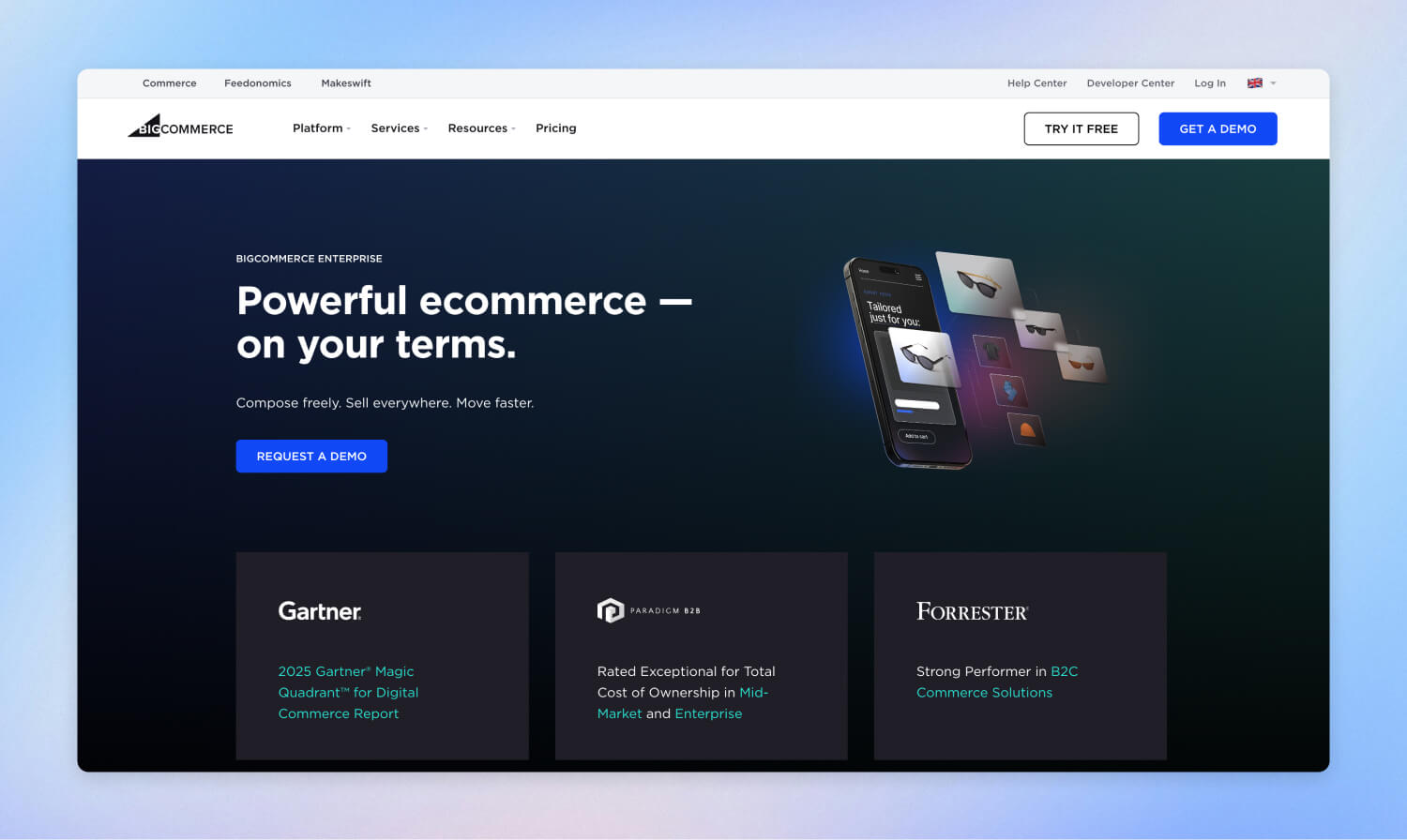
BigCommerce Enterprise sits between SaaS and composable commerce, offering strong API flexibility and native headless support with no transaction fees. It is well suited for hybrid B2B and B2C models, with built-in price lists, purchase orders, and account hierarchies.
BigCommerce Enterprise offers flexibility without requiring a fully custom build. The downside is its revenue-based pricing model that often pushes teams onto a higher plan before they need the extra features.
Key Features
- Open APIs: Native headless support and 1,200+ app integrations without platform-imposed front-end constraints.
- Zero Transaction Fees: No additional percentage charges regardless of payment gateway choice.
- Built-In SEO: Advanced URL control, CDN, and site speed optimisation without third-party dependency.
- Multi-Currency: Native support at no extra cost, with localised payment methods.
Pricing
✓Pros
- Strong native feature depth reduces app dependency
- Zero transaction fees regardless of payment gateway
- Headless-friendly without requiring full composable investment
✕Cons
- Automatic plan upgrades when sales thresholds exceeded
- Theme editor restricts layout customisation
5. Salesforce Commerce Cloud
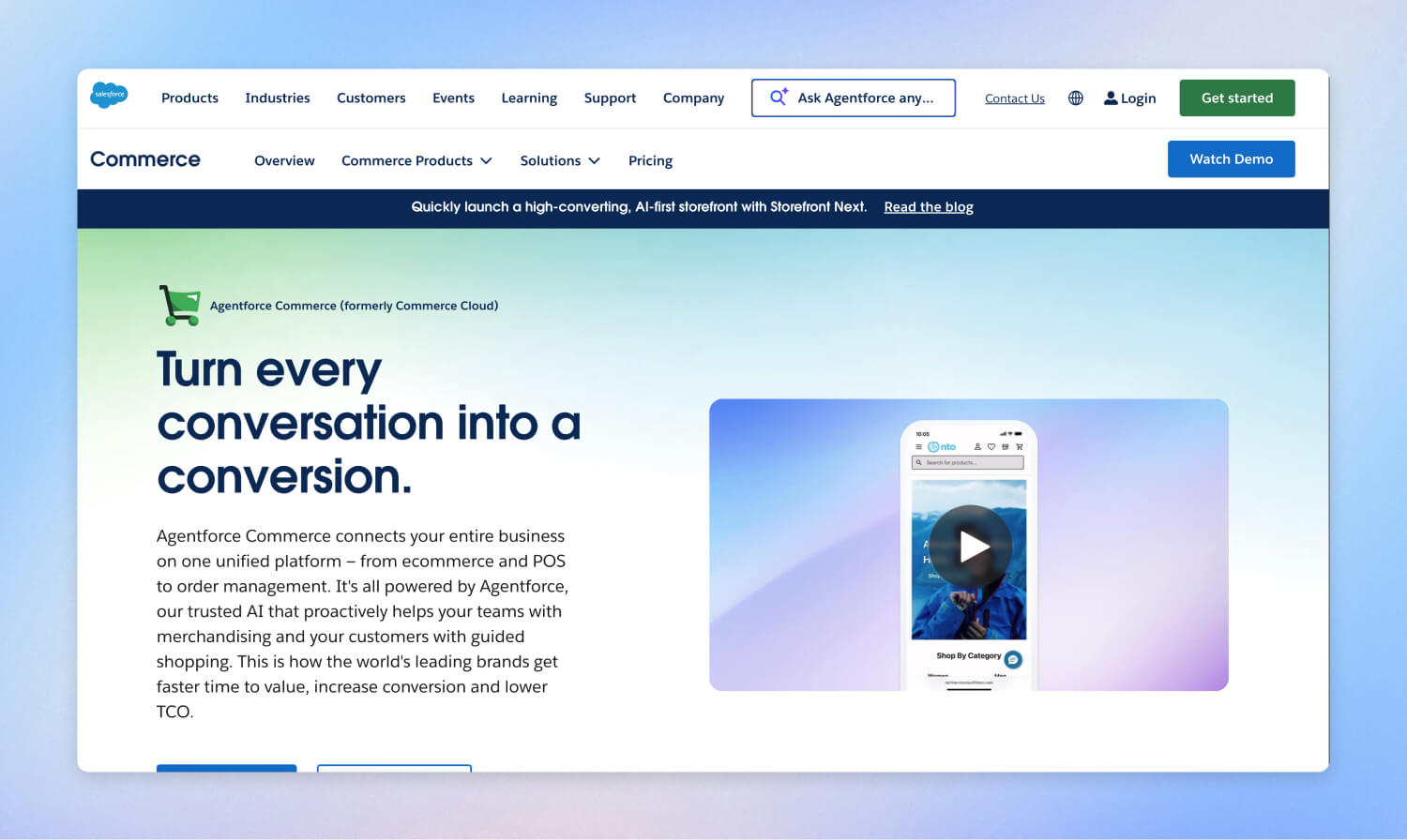
Salesforce Commerce Cloud is an enterprise eCommerce platform integrated with the Salesforce ecosystem. It connects CRM data, marketing automation, and commerce to enable advanced personalisation and segmentation.
Salesforce Commerce Cloud supports both B2C and B2B, though on separate backend systems, meaning more complexity to manage and maintain. Despite this, organisations where customer data drives strategy will find it particularly useful.
Key Features
- Einstein AI: Native predictive recommendations, search optimisation, and merchandising automation.
- CRM Integration: Deep Sales Cloud, Service Cloud, and Marketing Cloud connectivity for unified customer profiles.
- Omnichannel Order Management: Buy online pick up in-store (BOPIS), store-level inventory, and endless aisle capabilities.
- Multi-Site: Multi-currency, multi-language, and multi-brand from a single instance.
Pricing
GMV-based enterprise licensing, quote-based revenue share model, contact Salesforce sales directly.
✓Pros
- Unmatched CRM-connected personalisation and segmentation
- Strong omnichannel order management
- Mature global rollout capabilities with large partner network
✕Cons
- B2B and B2C run on different backend technologies
- High licensing and implementation costs; slow support response reported
6. commercetools
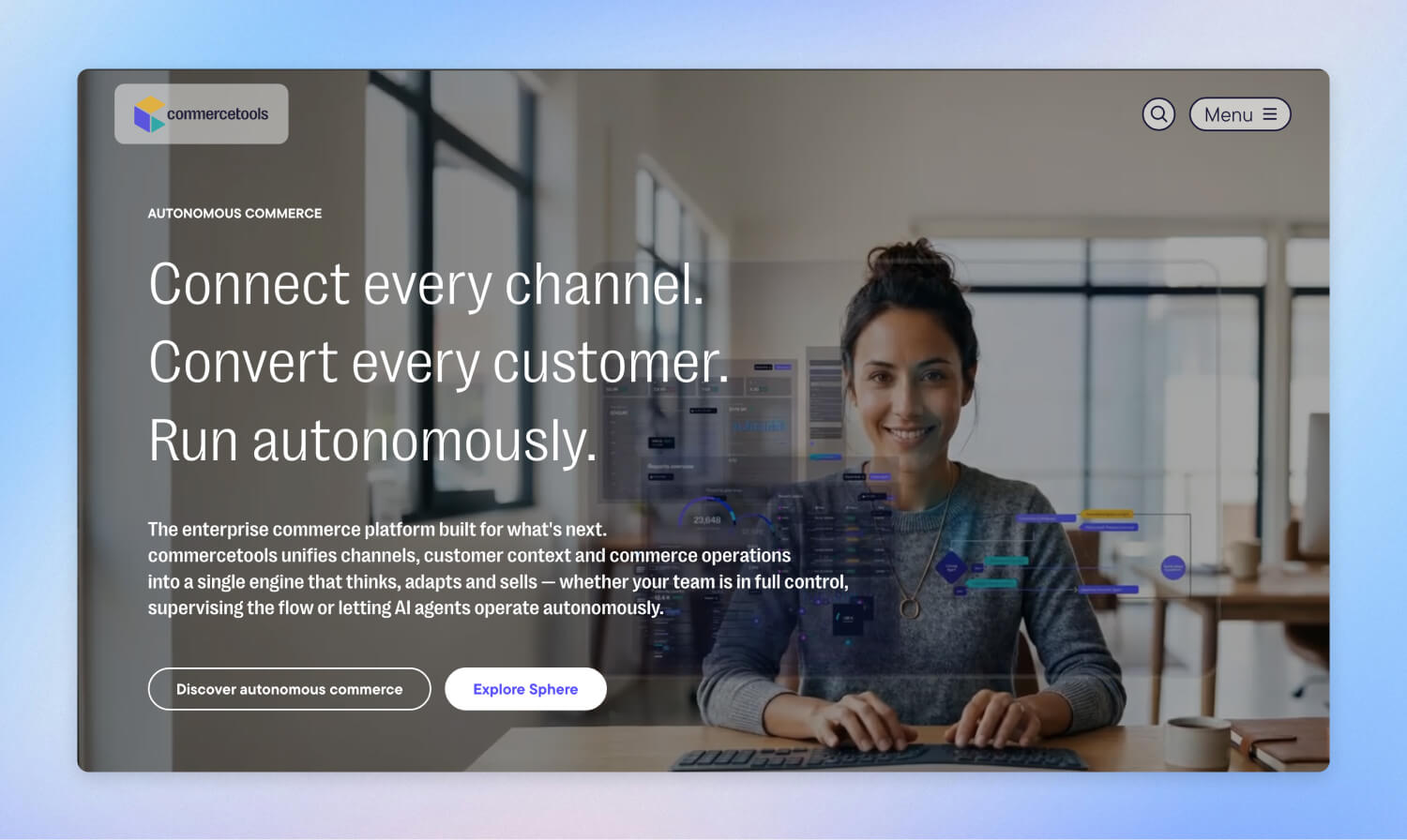
commercetools is a fully modular, AI-first enterprise commerce platform. It pioneered MACH architecture and is designed for composable enterprise stacks without vendor lock-in. It suits enterprises treating commerce as a fully owned software product. But non-technical businesses or those without a dedicated development team may find it difficult to build and maintain.
Key Features
- Extensive API Coverage: Provides 300+ REST and GraphQL endpoints for catalogue, cart, checkout, orders, and customers.
- Cloud-Native: Multi-tenant infrastructure on Google Cloud and AWS with auto-scaling.
- B2B Module: Account hierarchies, customer-specific pricing, quotes, and approval workflows.
- No Front-End Lock-In: Complete freedom to build any experience layer.
Pricing
Custom enterprise pricing based on transaction volumes and modules selected
✓Pros
- Maximum architectural flexibility; swap components without lock-in
- Strongest API granularity of any platform on this list
- Cloud-native scaling without infrastructure management
✕Cons
- Requires skilled architects and developers to configure and sustain
- No front end out of the box, every experience must be built
7. SAP Commerce Cloud (Hybris)
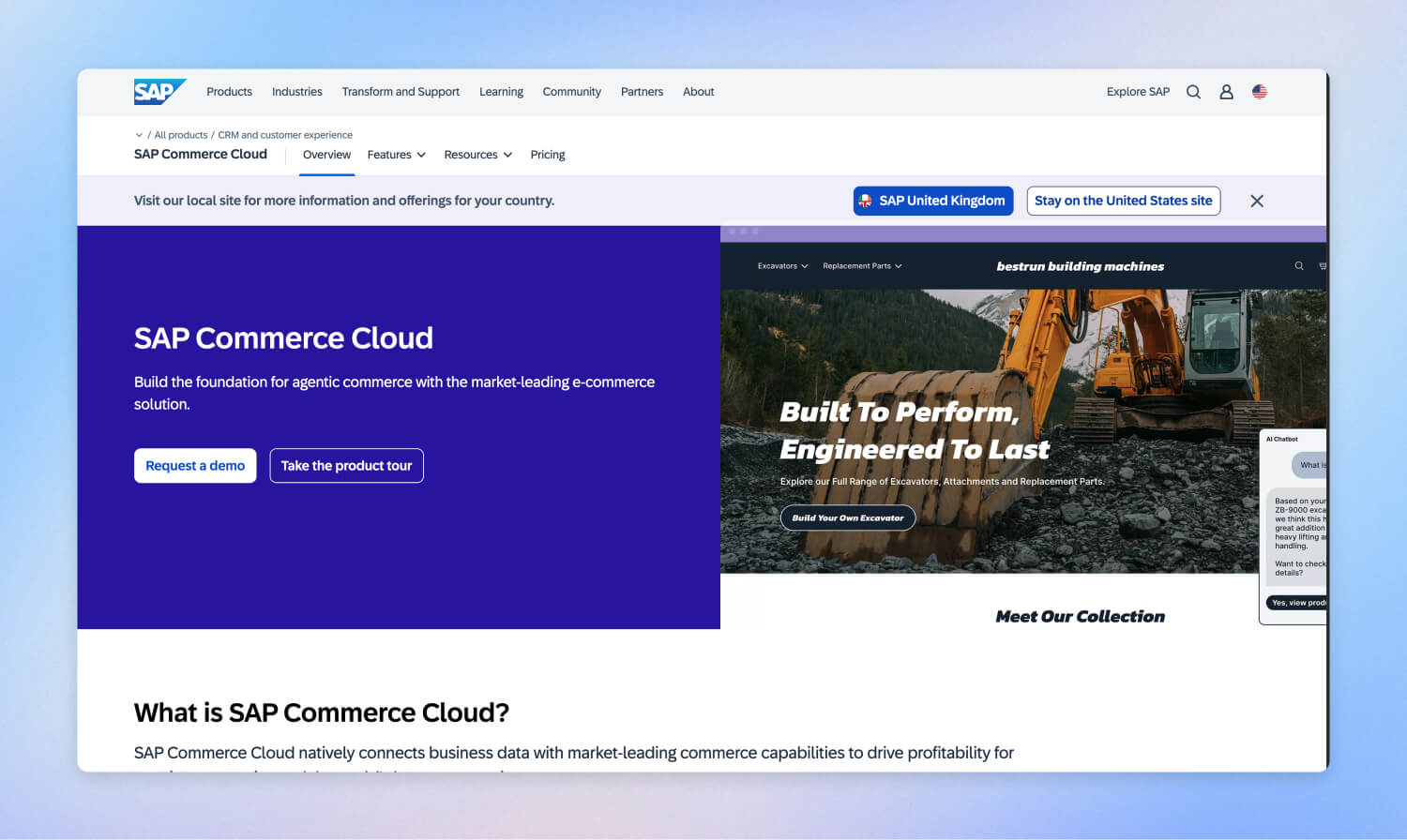
SAP Commerce Cloud is an enterprise eCommerce platform within the SAP ecosystem, designed for organisations already using SAP ERP or S/4HANA. It reduces integration complexity by connecting natively to core enterprise systems for inventory, customer, and order data. It is widely used by large enterprises with complex ERP-led operations.
Key Features
- Native SAP Integration: Direct connectors to SAP S/4HANA, SAP ERP, and SAP Analytics, no custom middleware.
- Complex catalogues: High-SKU management, configurable products, and contract pricing at enterprise scale.
- B2B Portal: Account hierarchies, self-service ordering, approval workflows, and quote management.
- Omnichannel: Web, mobile, and in-store commerce with strong order management.
Pricing
Quote-based; contact SAP sales directly
✓Pros
- Eliminates ERP integration complexity that breaks other platforms
- Mature multi-site, multi-currency production proven at scale
- Enterprise data governance built-in
✕Cons
- Annual licensing often reaches several hundred thousand dollars
- Requires specialised SAP developer skills at premium rates
8. Spryker
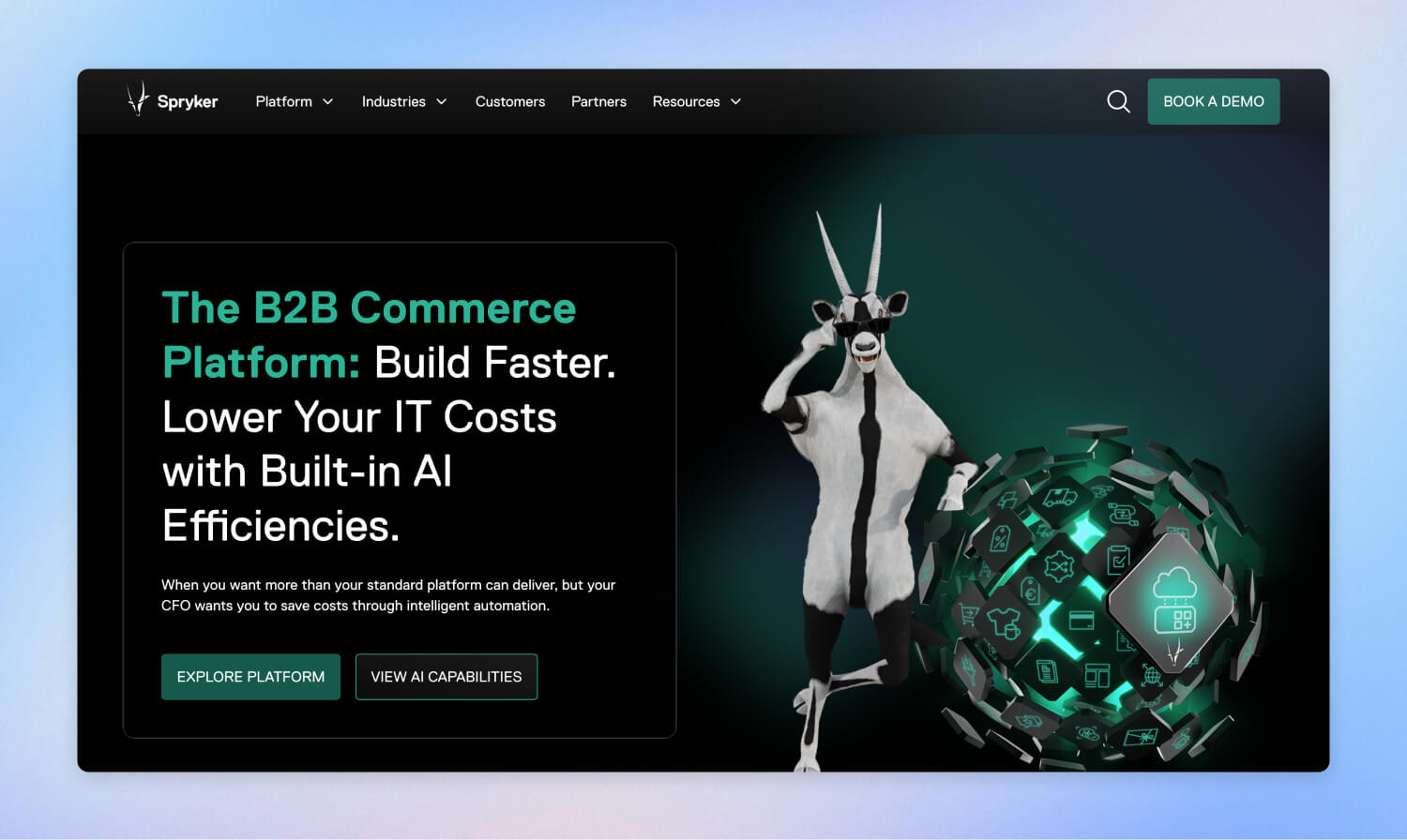
Spryker is a German enterprise eCommerce platform built for B2B and marketplace models. It works well for manufacturers and distributors with complex products, but often requires significant implementation effort and ongoing technical resources.
Key Features
- GLUE APIs: Service and channel integration layer for headless and composable builds.
- B2B Workflows: Quotes, procurement flows, and customisable product configurations.
- Marketplace Tools: Multi-vendor marketplace and IoT commerce capabilities.
- Mobile-First: Native mobile application support and PWA capabilities.
Pricing
Custom enterprise pricing
✓Pros
- Strong B2B-native architecture from day one
- Modular without requiring full composable build-from-scratch
- Good for marketplace and multi-vendor models
✕Cons
- U.S. presence and third-party ecosystem less mature than Adobe or Salesforce
- Requires strong technical foundation to implement effectively
9. Oracle Commerce Cloud
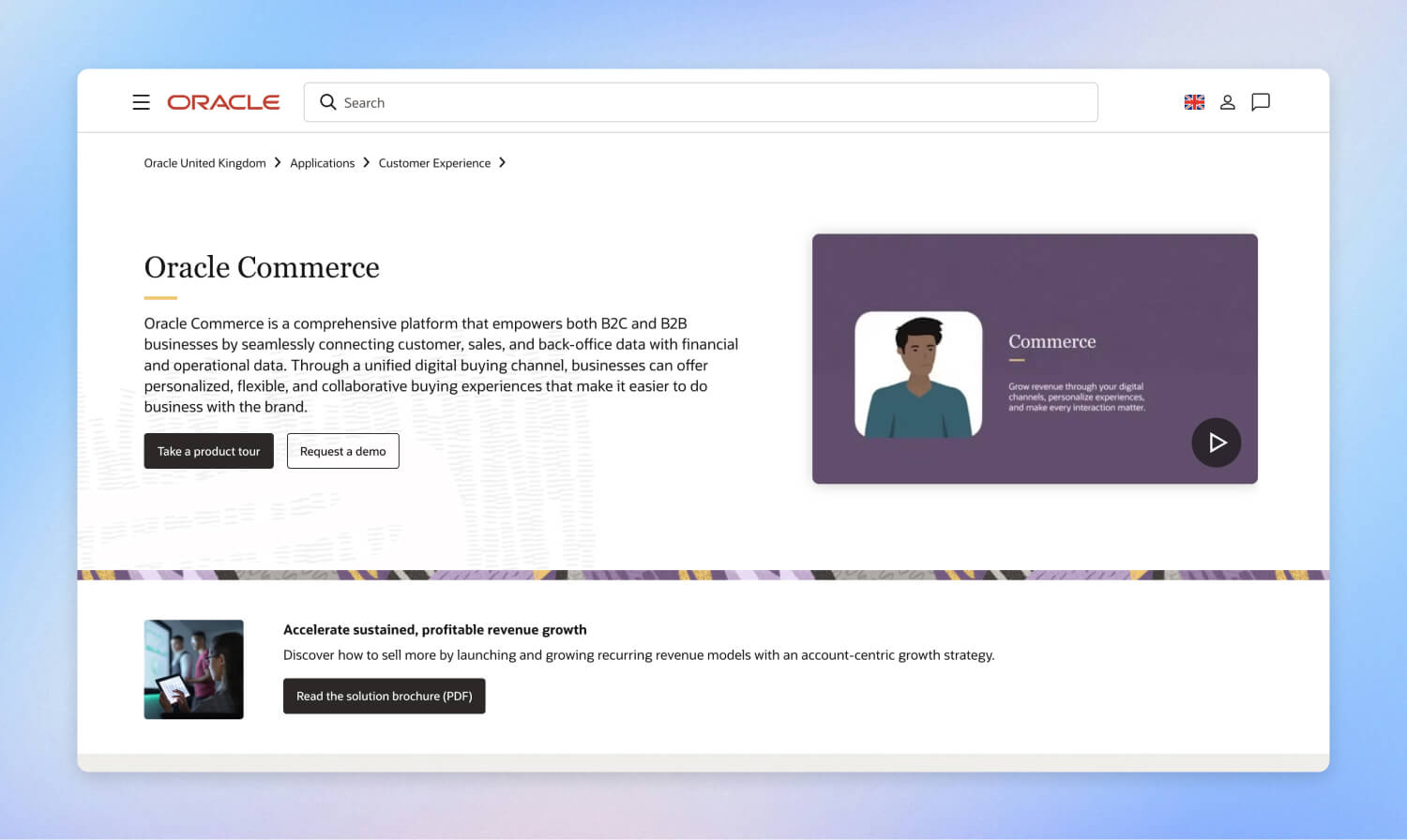
Oracle Commerce Cloud extends Oracle's enterprise suite into digital commerce, with strong analytics and marketing integration for organisations already using Oracle Cloud CX. It connects commerce with ERP and supply chain systems, allowing for unified data flow across operations. The platform supports cloud-managed deployments with enterprise-grade security for large-scale regulated environments.
Key Features
- Visual Builder: Pre-built layouts and widgets for rapid storefront creation without deep coding.
- API-First Architecture: REST APIs for agile development and simplified integrations.
- Native Oracle ERP: Direct connectivity to Oracle's financial and supply chain systems.
- Cloud-Managed: Automated patching and monitoring through Oracle Cloud infrastructure.
Pricing
Custom subscription/usage-based; implementation costs significant
✓Pros
- Strong analytics and marketing integration within Oracle stack
- Enterprise security and compliance posture
- Cloud-managed patching reduces operational burden
✕Cons
- Complex implementation with heavy customisation requires structured dev/testing cycles
- Less flexible outside Oracle ecosystem
10. OroCommerce
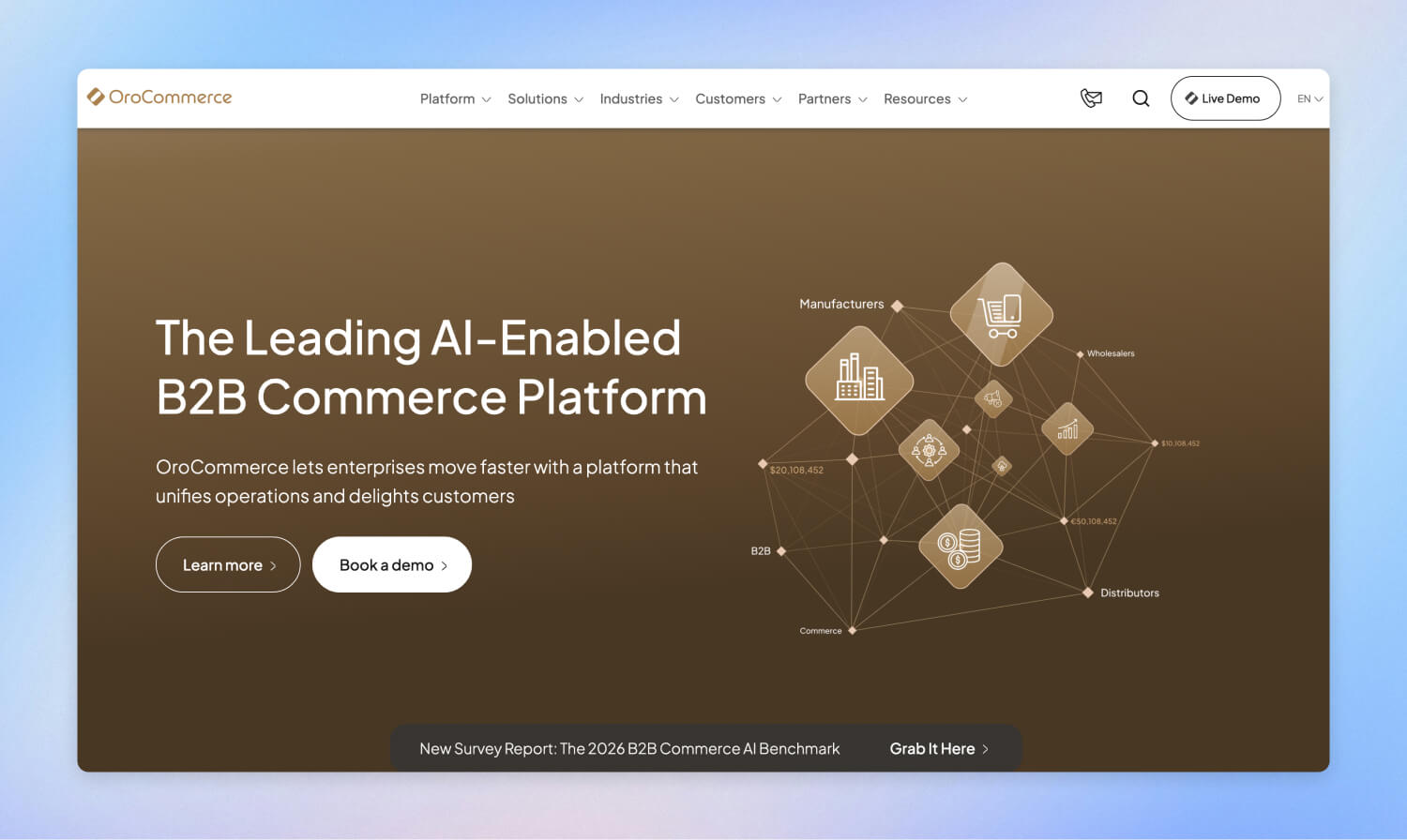
OroCommerce is an enterprise B2B eCommerce platform that combines eCommerce, CRM, CPQ, AI, and ERP connectors under a single license with no per-site fees. It unifies core business functions natively rather than relying on integrations. This makes it well suited for manufacturers and distributors with complex, multi-step sales processes.
Key Features
- Unified Platform: eCommerce, CRM, CPQ, CMS, PIM, DAM, invoicing, and payments in one product.
- Account Hierarchies: Granular roles and delegated purchasing across complex organisational structures.
- CPQ and RFQ: Integrated configure-price-quote and request-for-quote with multi-round negotiation.
- OroIQ: Native AI for order automation, back-office task optimisation, and predictive analytics.
Pricing
"One platform, one license" no per-site or usage-based charges, custom enterprise pricing.
✓Pros
- Only platform where eCommerce, CRM, CPQ, and ERP connectors ship as one product
- Meaningful for multi-brand enterprises
- Strong B2B-native workflow depth
✕Cons
- Smaller ecosystem than Adobe or Salesforce
- Less proven at massive B2C scale
Join 3,000+ brands running their wholesale operation with SparkLayer.
Add enterprise B2B on top of your existing store - no replatform required.
Ready to Add Enterprise B2B to Your Store?
If you're already selling wholesale on Shopify, you often don't need a new platform to reach enterprise B2B depth. In most cases, the better move is adding a layer that works with what you already have.
SparkLayer adds enterprise B2B capability directly on top of Shopify without replacing the underlying store. As one customer put it, "You wouldn't even notice these guys exist." It runs on your existing setup while powering full B2B operations behind the scenes.
Book a demo today to see if SparkLayer fits your wholesale operation.