






Quick summary
Connecting your Shopify store to an ERP should mean one source of truth for pricing, inventory, and orders. The best Shopify ERP integration solutions eliminate manual data entry and keep your B2B buyers working from accurate information every time they log in.
For more on scaling wholesale, explore our best practice guides.
Here are our top three picks:
| # | Tool | Best For |
|---|---|---|
| 1 | SparkLayer | B2B wholesale brands wanting their trade portal connected directly to their ERP |
| 2 | NetSuite | Enterprise B2B brands needing finance, inventory, and CRM under one licence |
| 3 | Microsoft Dynamics 365 Business Central | Mid-market brands in the Microsoft ecosystem |
SparkLayer works with a global range of integration partners
SparkLayer is a B2B eCommerce specialist trusted by 3,000+ global brands including Schneider Electric, Gentec, and Specialised Welding Products. We have helped manufacturers, distributors, and wholesale brands connect their existing stores to the ERP systems their businesses already run on.
We know firsthand where those integrations break at scale. Pricing lives in the ERP but gets updated manually in the store. Orders come in through the portal but need re-entry into the warehouse system. Stock figures are always a day behind.
SparkLayer connects natively to a growing list of operations and finance platforms. For ERPs that are not directly connected, integrations can be built using iPaaS solutions such as Patchworks and Versori. See the full list of SparkLayer integrations.
The best Shopify ERP integration solutions compared
Compare the top Shopify ERP integration solutions for B2B wholesale.
| # | ERP Solution | Native Shopify Integration | B2B Pricing Sync | Quote to Order | Free Trial |
|---|---|---|---|---|---|
| 1 | SparkLayer | Native | Customer-specific, tiered and volume pricing | Yes | 14 days |
| 2 | NetSuite | Via iPaaS (Patchworks, Celigo) | Advanced pricing | Yes | No |
| 3 | Microsoft Dynamics 365 Business Central | Via iPaaS or connector apps | Customer-specific pricing | No | Yes |
| 4 | SAP Business One | Via connector apps or iPaaS | Customer-specific and price lists | No | No |
| 5 | Odoo | Via connector apps or iPaaS | Customer-specific pricing | Yes | Yes (Community) |
1. SparkLayer
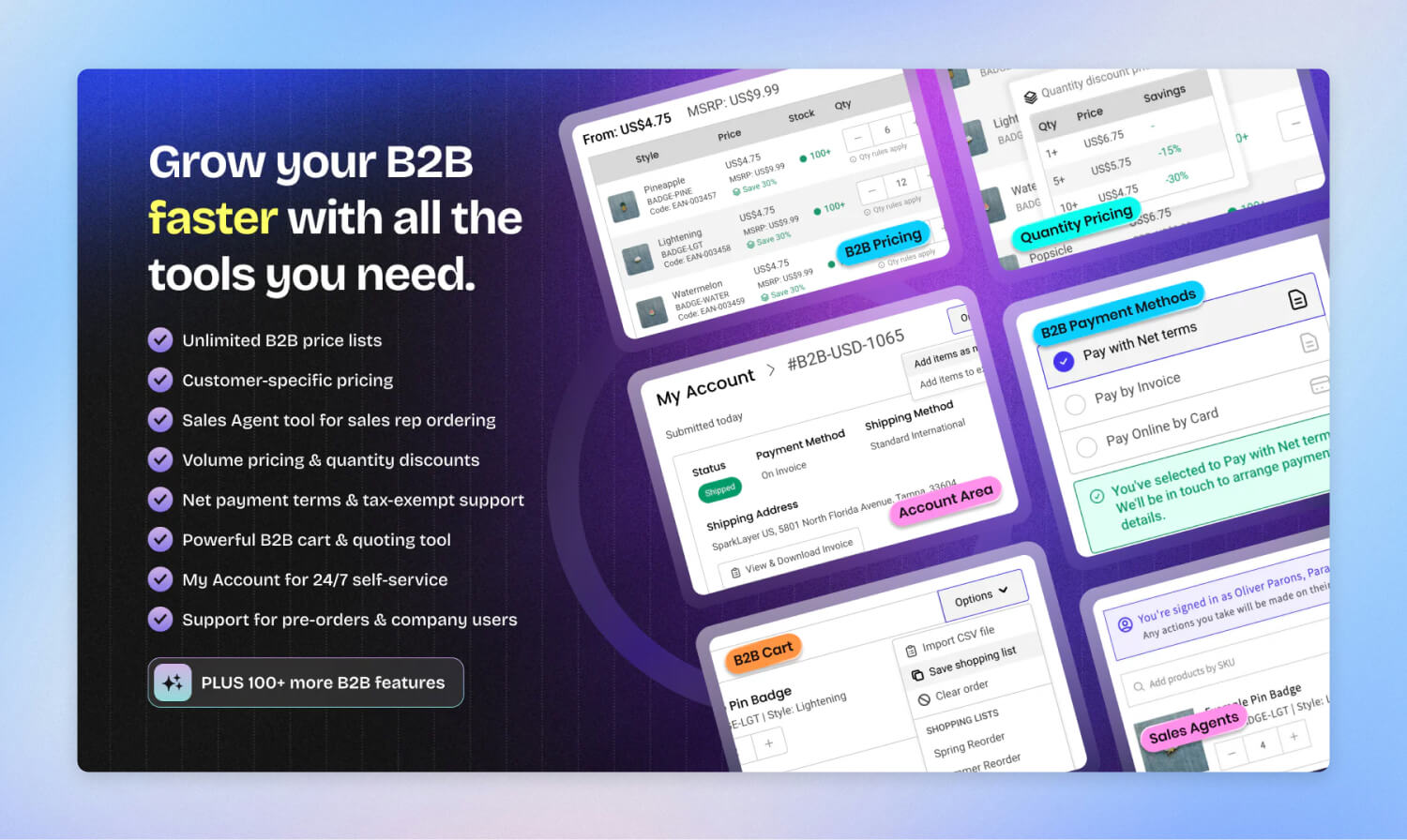
SparkLayer is the missing layer between your existing store and the ERP your business already runs on. Instead of managing product information, pricing, and orders across separate systems, SparkLayer keeps everything in sync with your ERP.
Buyers can log into your wholesale portal, see real-time pricing, stock, and account information pulled directly from your ERP. Every order syncs back automatically, eliminating batch jobs and reducing discrepancies.
SparkLayer connects natively to Brightpearl, Katana, Linnworks, Cin7, Conjura, and Unleashed, as well as Xero and QuickBooks Online for accounting. For brands connecting via iPaaS, Patchworks and Versori are also supported. The Sales Agent Portal lets your reps place orders on behalf of buyers using live ERP pricing, and the Quoting Engine handles negotiated pricing workflows that feed directly back into your order management system.
The AI Intelligent Cart reads emailed purchase orders and builds the cart automatically, so even buyers who send spreadsheets or PDFs get their orders into the system without your team manually entering order details.
SparkLayer also works natively on Shopify, BigCommerce, Wix, and WooCommerce. For brands on other platforms, SparkLayer Ignite is the B2B Commerce Framework that makes the same integration possible on any website or custom platform.
✓Pros
- Connects to all major ERPs used by B2B wholesale brands, with real-time two-way sync
- Trade buyers see live ERP pricing and stock the moment they log into the portal
- Sales Agent Portal and Quoting Engine both draw from ERP data, keeping negotiations accurate
- Free plan available with no credit card required, paid plans from $49/month
- Keeps orders, invoices, and customer accounts in one connected system
✕Cons
- Best suited for businesses already selling wholesale online
2. NetSuite
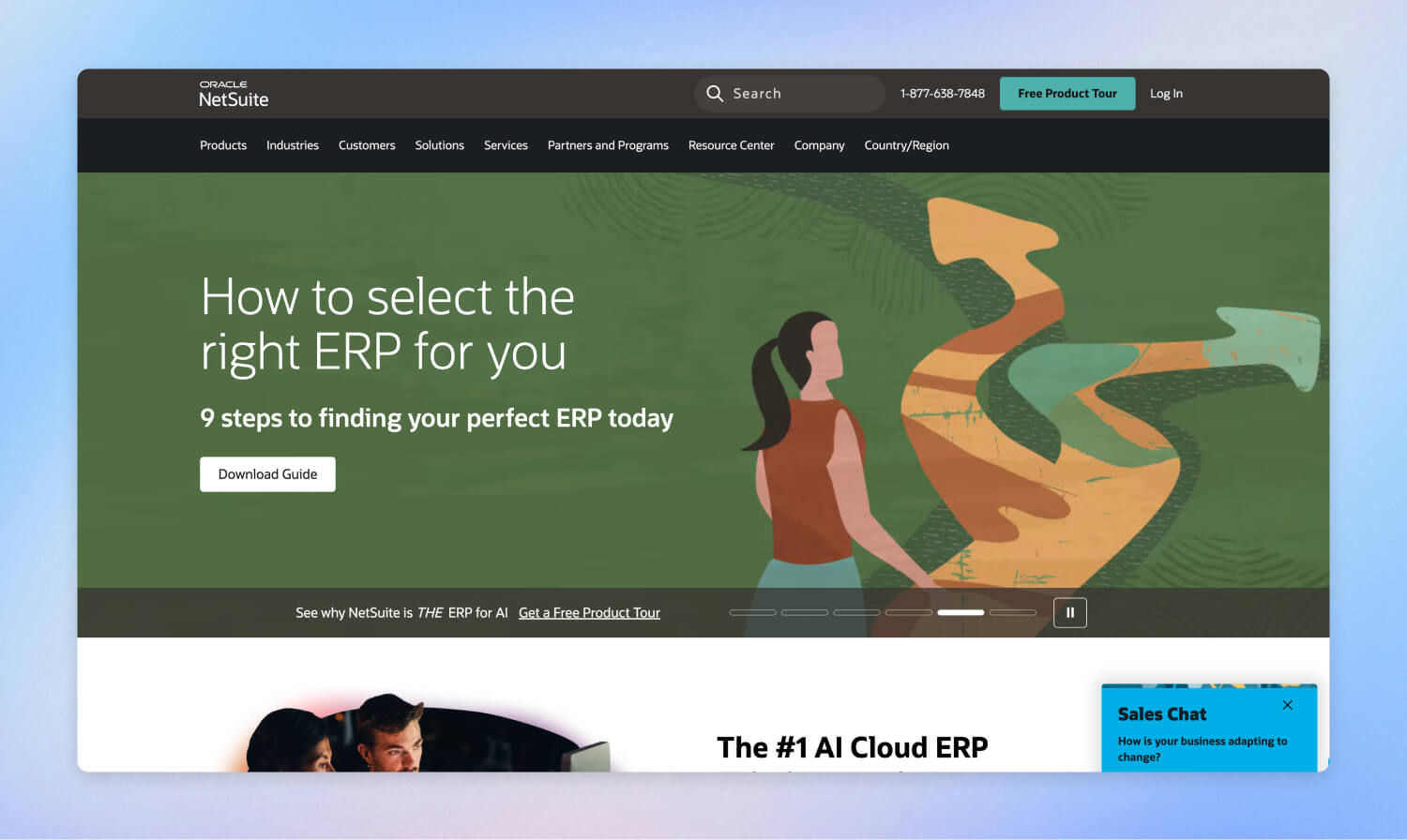
Oracle NetSuite covers financials, inventory, order management, CRM, procurement, and reporting in a single platform, making it the natural choice for enterprise-scale B2B operations where multiple departments need a shared source of truth.
For brands operating across multiple countries and warehouse locations, NetSuite handles complexity that mid-market ERPs cannot, including intercompany transactions, localised tax rules, and consolidated reporting across entities. The trade-off is implementation time and cost, NetSuite is rarely a quick or inexpensive project to get live.
✓Pros
- Covers finance, inventory, CRM, and order management in one platform with no integration gaps
- Scales across multiple countries, currencies, and warehouse locations without additional tools
- Handles multi-entity and intercompany transactions natively, useful for brands operating across multiple legal entities or regions
- Strong reporting gives every department a single, accurate view of the business
✕Cons
- High total cost of ownership once implementation, customisation, and ongoing support are factored in
- Requires ongoing specialist support to maintain customisations as the business grows
- Overkill for brands that do not need full enterprise ERP capability across every business function
3. Microsoft Dynamics 365 Business Central
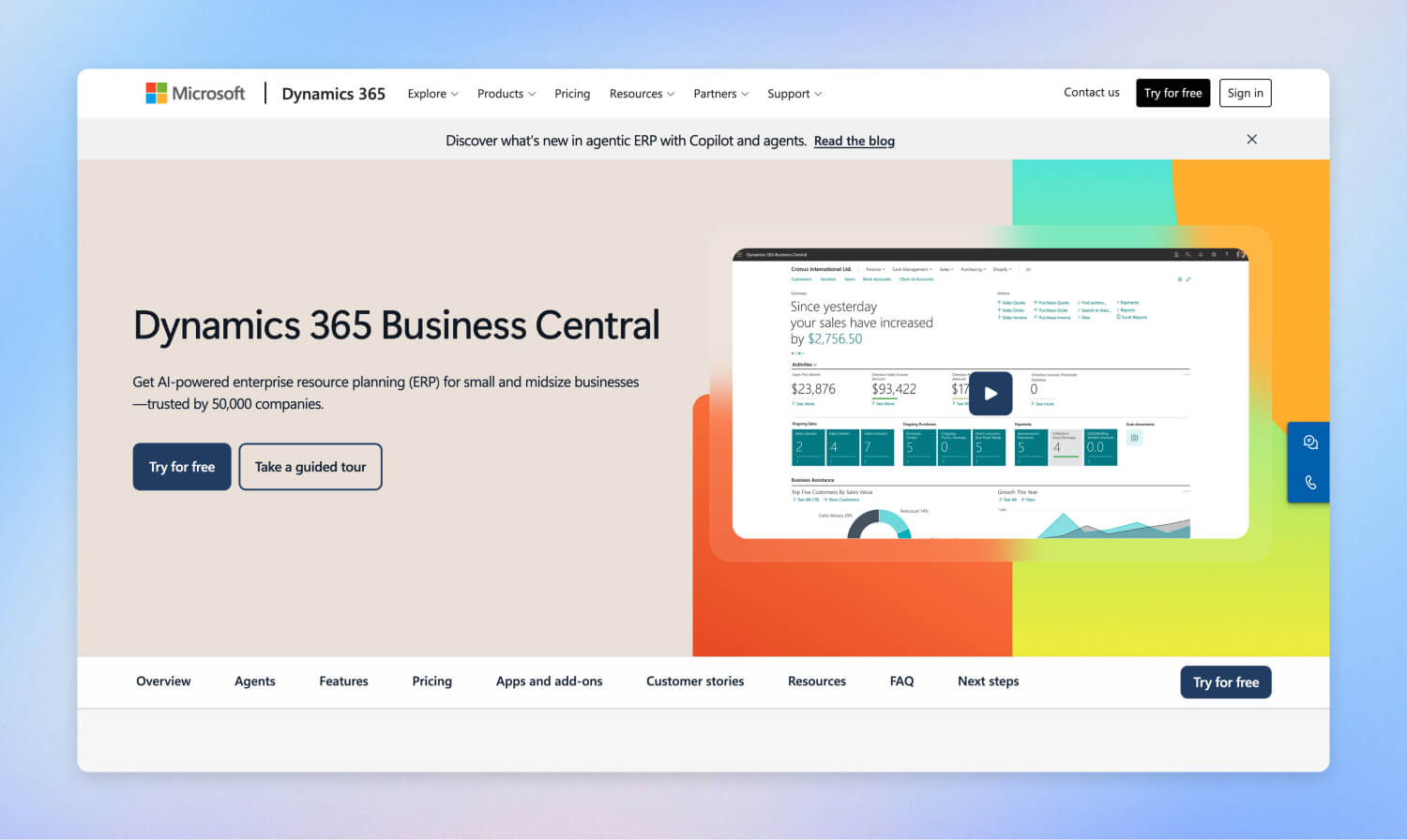
Microsoft Dynamics 365 Business Central is purpose-built for small and mid-sized businesses. It covers financials, inventory, supply chain, purchasing, and project management, and integrates tightly with Microsoft 365, Teams, and Power BI. For brands already running the Microsoft stack, Business Central is a natural fit. It connects to Shopify via connector apps and iPaaS solutions, keeping inventory, pricing, and order data in sync across both systems.
Copilot AI features are embedded directly into Business Central workflows, automating routine financial reporting, flagging anomalies, and surfacing predictive insights without additional configuration. Implementation typically takes three to six months for a standard mid-market deployment.
✓Pros
- Deep integration with Microsoft 365, Teams, and Power BI for brands already in the Microsoft ecosystem
- Copilot AI features embedded into everyday workflows at no extra module cost
- Strong mid-market fit with a lower total cost of ownership than enterprise ERPs like NetSuite
- Scales well as the business grows without forcing an early migration to a more complex platform
✕Cons
- Shopify connection requires iPaaS or third-party connector apps rather than a native integration
- Less suited for brands with genuinely complex multi-entity or multi-country operations
- Requires a certified Microsoft partner for implementation, adding to the total cost of deployment
4. SAP Business One
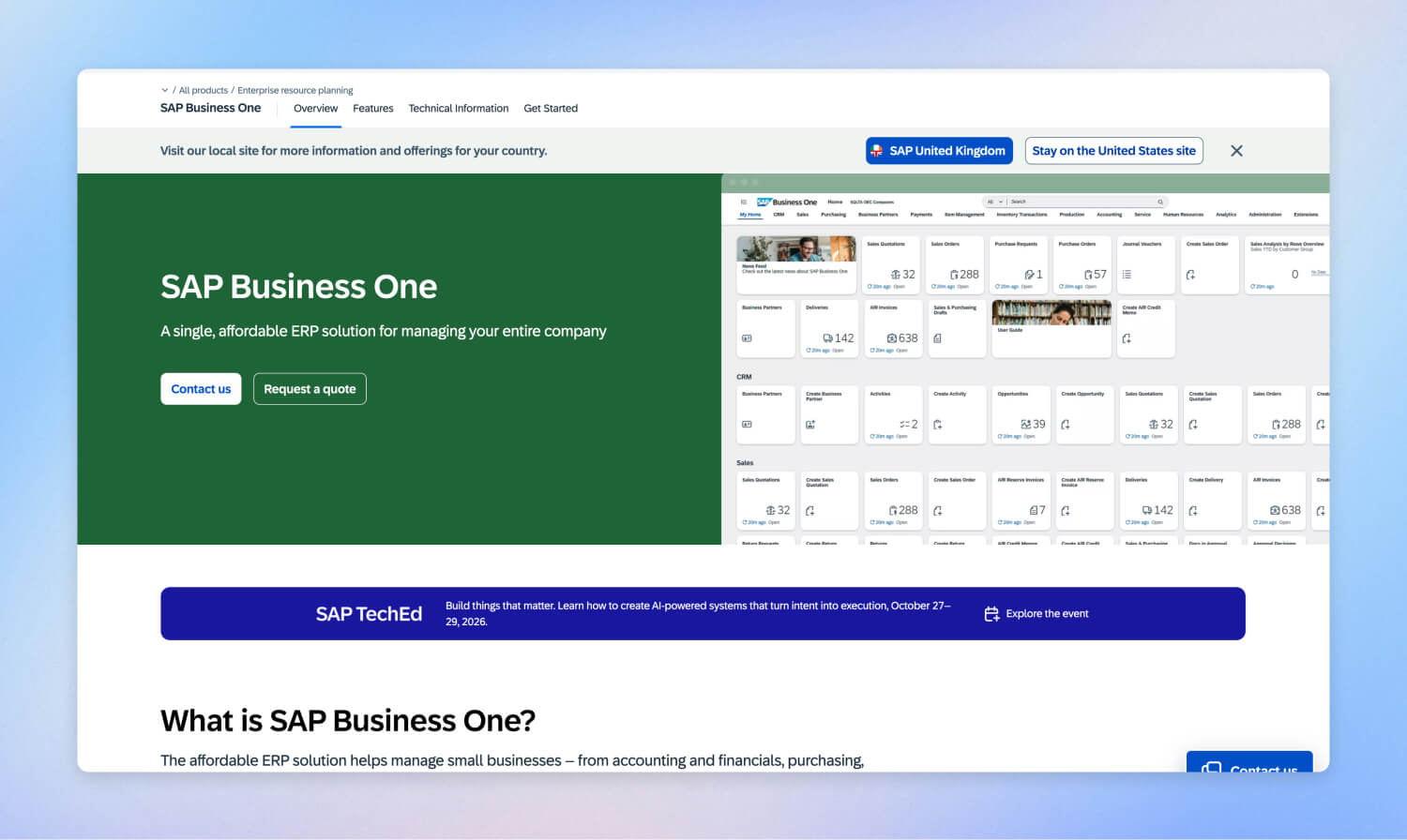
SAP Business One is SAP's ERP solution for small and mid-sized businesses. It covers financials, inventory, sales, purchasing, and production in one system, and has a strong track record in manufacturing and distribution environments where stock accuracy and purchase order management are critical. It connects to Shopify via connector apps and iPaaS solutions including APPSeCONNECT and Celigo, syncing products, inventory, pricing, and orders between SAP and your Shopify storefront in real time.
SAP Business One runs on HANA or SQL databases and can be deployed in the cloud or on-premises. Implementation typically takes two to four months for a standard SMB deployment, making it faster to go live than enterprise ERPs at a comparable capability level.
✓Pros
- Strong inventory and production management built specifically for manufacturing and distribution
- Flexible deployment options, cloud or on-premises depending on your infrastructure requirements
- Faster implementation than enterprise ERPs, typically two to four months for SMB deployments
- Broad add-on ecosystem covering warehouse management, logistics, and industry-specific compliance
✕Cons
- No native Shopify connector, requires iPaaS or third-party connector apps to integrate
- Implementation requires technical expertise and careful planning
- Customisations can increase costs and maintenance needs
5. Odoo
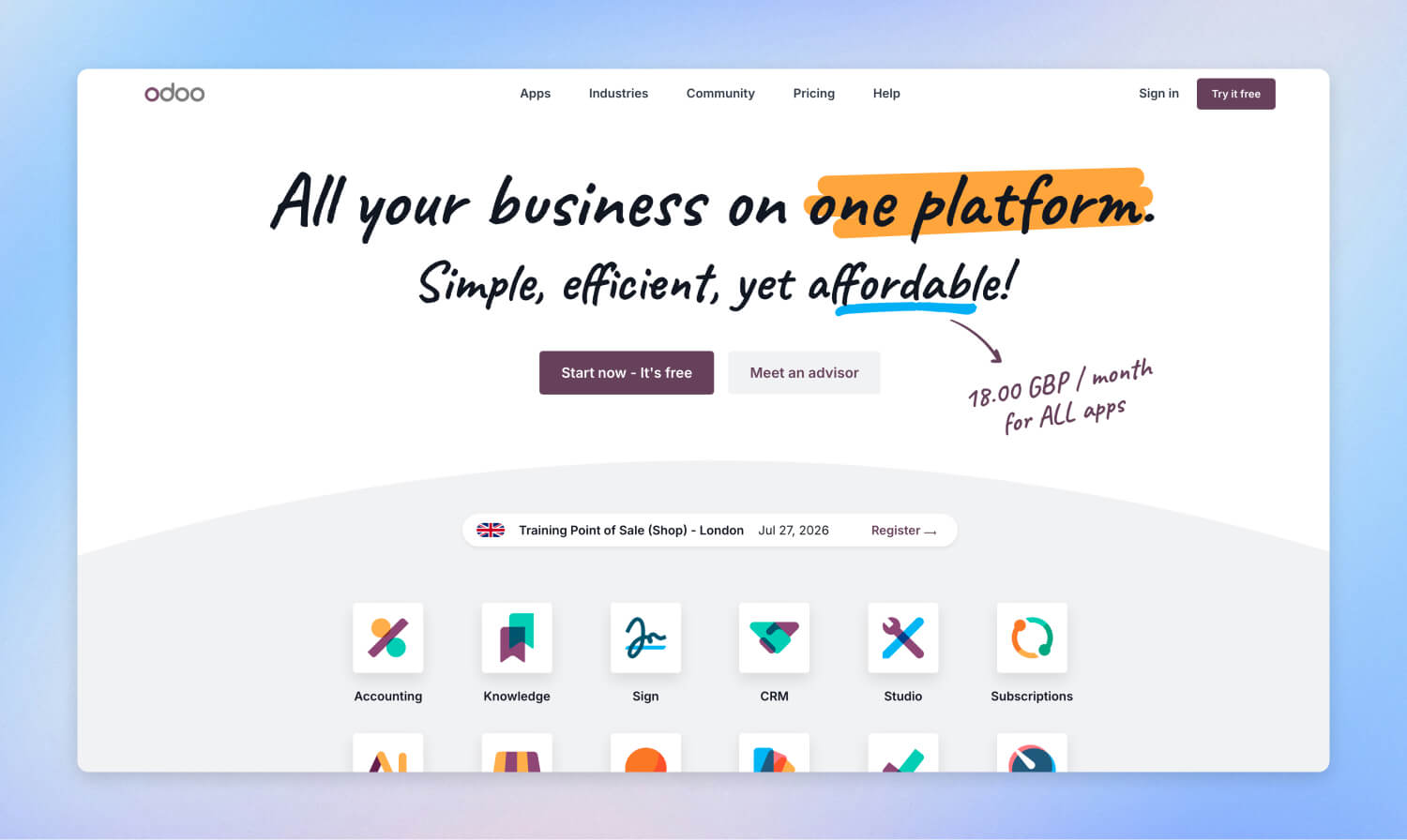
Odoo is an open-source ERP platform covering finance, inventory, purchasing, manufacturing, CRM, and eCommerce in one modular system. It is the most affordable option on this list, with a free One App plan and paid plans from $24.90/user/month covering all apps. Odoo connects to Shopify via connector apps, syncing products, inventory, orders, and customer data between both systems.
Odoo's modular structure means brands can start with the modules they need and add more as the business grows. Implementation typically takes one to four months for most SMB deployments, and the platform is known for a clean interface that most teams find straightforward to adopt without heavy developer involvement.
✓Pros
- Most affordable ERP on this list with a free Community edition available for brands starting out
- Modular structure lets brands start with core needs and expand without switching platforms
- Fast implementation, typically one to four months for most SMB deployments
- Open-source architecture gives brands full control over customisation and data
✕Cons
- Free Community edition has no official support, updates and maintenance fall on your team
- Shopify connection requires third-party connector apps rather than a native integration
- Enterprise support and customisation costs can add up quickly for complex deployments
Ready to connect your ERP to your B2B wholesale channel?
SparkLayer connects directly to all five ERPs on this list, so your pricing, inventory, and order data stays in sync without manual updates between systems. Trade buyers see live stock and accurate pricing the moment they log in, and every order placed through your B2B portal syncs back to your ERP automatically.
Start free, or book a demo to see how SparkLayer connects to your existing systems.